Finnish Game
The Finnish Game series has been published since 1946. Last year (2024) the 70th volume of the series was published. Suomen Riista is an internationally renowned publication in the field of game science, containing a wide range of the latest research data on various aspects of game research.
The editor-in-chief of Suomen Riistan is D.Sc./Dos. Jani Pellikka (Natural Resources Institute Finland), the corresponding editor is Veli-Matti Väänänen, PhD (University of Helsinki) and the layout is by Tero Salmela. The Editorial Board consists of Research Professor Ilpo Kojola (Natural Resources Institute Finland), University Lecturer Janne Sundell (University of Helsinki), Professor Mikko Mönkkönen (University of Jyväskylä), Research Professor Emeritus Hannu Pöysä (Natural Resources Institute Finland) and Research Vice-Rector Osmo Rätti (University of Lapland).
Subscription
Printed issues of Suomen Riista can be ordered by e-mail, using the order form (below) or by phone on 050 301 2647. The price is 20 € + delivery costs.
THE LATEST ISSUE
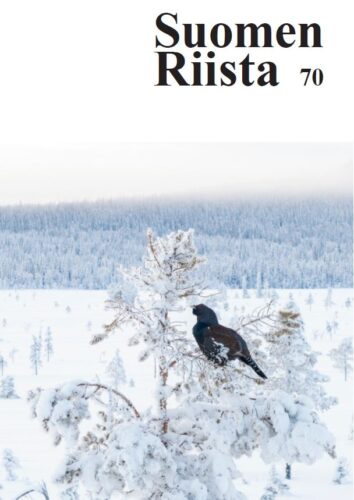
Suomen Riista 70
- Jani Pellikka: Speech: Hunting to health?
- Miikka Husa & Jani Pellikka: The current state of game bird hunting in Northern Finland – who gets the prey, where and when?
- Piia Ikonen & Jani Pellikka: How to promote the restoration of game habitats on private land?
- Veli-Matti Väänänen ja Hannu Pöysä: Waterfowl catch in constructed wetlands
- Kunnasranta Mervi, Miettinen Elmo, Gavrilov Markku, Holmala Katja, Iso-Touru Terhi,Melin Markus, Meller Anna, Ruha Leena, Timonen Petri, Valtonen Mia, Väänänen Veli-Matti: Wild boar in Finland – towards more comprehensive research data
Buy a volume


Guidelines for writers
Suomen Riista is published as one volume per year. Articles published concern game science: research reports, methodological studies, literature-based reviews and thematic articles. Manuscripts sent to the editorial office go through a peer review system where two external experts, anonymously or under their own names, assess the suitability of the manuscript for publication in Suomen Riista, and provide comments to support the finalisation of the manuscript if necessary. The evaluators are mainly professional researchers from Finnish universities or research institutes, with PhDs and associate professorships, who are familiar with the subject area and methods of the manuscript.
Style and structure
The manuscript is written in accordance with the general principles of research reporting. For details, please refer to the most recent issues of the publication.The text is written with maximum line spacing, leaving a margin of 3 cm on the left-hand side. No splicing or right-hand side selvedge smoothing is used. The title, author names and introduction are placed at the beginning of the body text, not on a separate title page. Capital letters (versals) are not used. Two blank lines are left above the subheadings and one below. A new paragraph is started with an indentation made with the column key, except after the heading and subheadings, in which case there is no indentation. Forced line breaks are only necessary for paragraph splitting, and are not preceded by a word space (blank space).
Summary
The author writes an English abstract of the article, including references to all tables and figures but without bibliographical references. Table and figure texts are also translated into English. The language check is carried out by the supplier, and by agreement also the language translation.
Scientific names of species and surnames are written without brackets and in italics. The names of tribes are not italicised, nor is the species abbreviation sp.
Numerical values and abbreviations
The dates are given in Finnish as 21.6.1983 and 21-27.6.1983; in English as 21 June 1983 and from 21 to 27 June 1983. The decimal point is a dot. Thousands are separated from hundreds by a space (2 500). In the English text, thousands are separated by a comma (2,500), decimals by a full stop. Mathematical abbreviations are not italicised and are written without periods (e.g. t, x+, SD, SE, CV, n, r, df, P, NS). Leave a word gap on either side of the equal sign or the comparing sign (P = 0.04; P
Graphics and tables
All images sent for delivery will be made up to 2 times the width of the bale in full. If the images are sent by email, they should be attached as separate files in TIFF or EPS format. The font should be Times new roman. In figures and tables, the English counterterm is written in italics after the Finnish text, in lower case and separated by a comma (e.g. Lajimäärä, species number) or below it in upper case without a comma. The photos are numbered sequentially and their captions are written on a separate strip in numbered order.
References and bibliography
The current practice of Finnish Game must be strictly followed in the drafting process. Examples: (Angelstam 1983a, b); (Anon. 1981); Anon. (1981) states …; Bryant & Kuropat (1980) states …; Bryant et al. (1983) states …; von Haartman et al. (1963-72) state …; Sarbello (1973, after Korschgen 1977) stated … – Form “Anon.” is used when the author of the source text of the reference is not known and it is not an official statement by the publisher, otherwise the reference is direct (e.g. Environmental Statistics 1980). In the Finnish text the forms “suull. ilm.”, “kirj. ilm.”, “julkaisematon” are used, in the English text “pers. comm.”, “in litt.”, “unpubl.”. Do not indent the bibliography; use forced line breaks only at the end of each reference, not on every line; do not leave a blank line between references.
In the bibliography, in addition to the name of the Finnish-language articles, the name of the congress proceedings is also given in brackets whenever there is one. Similarly, if a congress article has a Finnish abstract, this is also mentioned. In the absence of a congress-language commentary, the language in which the article is written (e.g. in Finnish) is indicated in brackets. If the article has been translated, this is indicated (e.g. translation from Russian). If only the title of the article has been translated (and not transliterated), the translation title is given as the title of the article and is enclosed in square brackets.
When abbreviating the names of publication series, it is primarily the practice of the series themselves to do so. Foreign forms of Finnish series such as “Fennica”, “Fennicae”, etc. are not abbreviated. If the series does not indicate its year, the bibliography should indicate the number/year of publication of the journal concerned: pages (e.g. No 7/1983: 13-16).
Manuscripts. The closing date is 15 December. In the first instance, authors should send their texts by e-mail or two printed versions by post to the editor responsible. The preferred format for the text is Word. The text file should include tables and figures. Typological details of the text, such as bold, italics, superscripts, subscripts, etc., can be included in the text as normal. After review and correction, the text is returned and the author transfers the corrections to the file. The file and images are returned as separate files to the editor by e-mail or other means. The text will be edited by the editorial office into a ready-to-fold format for submission to the printer. The author will receive a printed proof, to which corrections can be made within the limits of the layout. Authors will receive a pdf file of their article.